eDIVE Platform
Summary
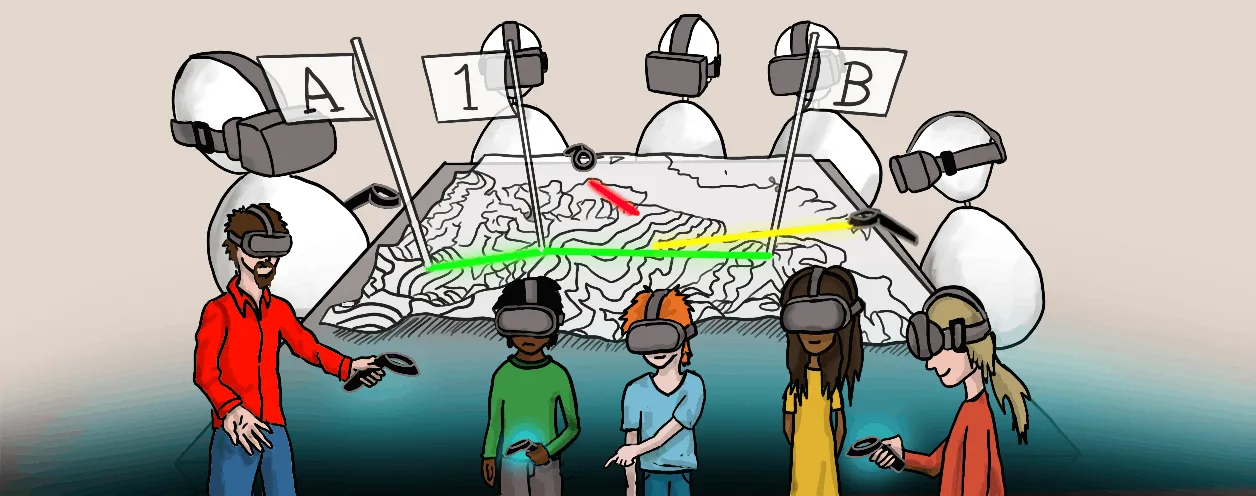
eDIVE is an extensible VR software platform for developing collaborative immersive educational experiences. Built in Unity and created as part of the EduInCIVE project, it empowers developers to design and deliver multi-user VR learning scenarios with custom features for teachers, students, and researchers.
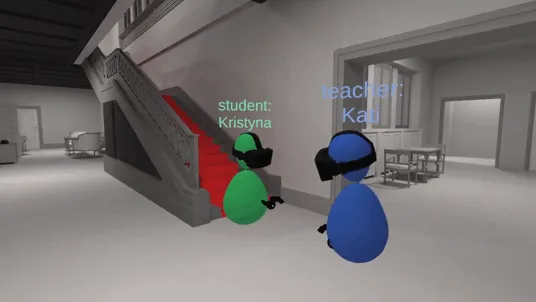
eDIVE Platform
Summary
eDIVE is an extensible VR software platform for developing collaborative immersive educational experiences. Built in Unity and created as part of the EduInCIVE project, it empowers developers to design and deliver multi-user VR learning scenarios with custom features for teachers, students, and researchers.


Overview
eDIVE is an open-source, collaborative Virtual Reality architectural framework focused on education and human-computer interaction research. Developed as part of the EduInCIVE project, it directly addresses a critical gap in the XR industry: the polarization between raw game engines (which pose a massive technical barrier for creators) and rigid social VR platforms (which lack deep customization and pedagogical validation).
As the lead Creative Technologist and system architect, I was responsible for designing and implementing the entire platform. eDIVE acts as a “middle-ground” architecture that abstracts complex networking while retaining absolute creative flexibility.
Dual-Ecosystem Approach
The architecture was intentionally designed to satisfy two distinct target groups, delivering tailored benefits to both:
- For Creators (Developers & Designers): eDIVE provides an extensible Unity-based foundation. By streamlining workflows and handling the heavy lifting of multiplayer networking, avatars, and logging, it gives creators the freedom to focus purely on custom interactions and educational content.
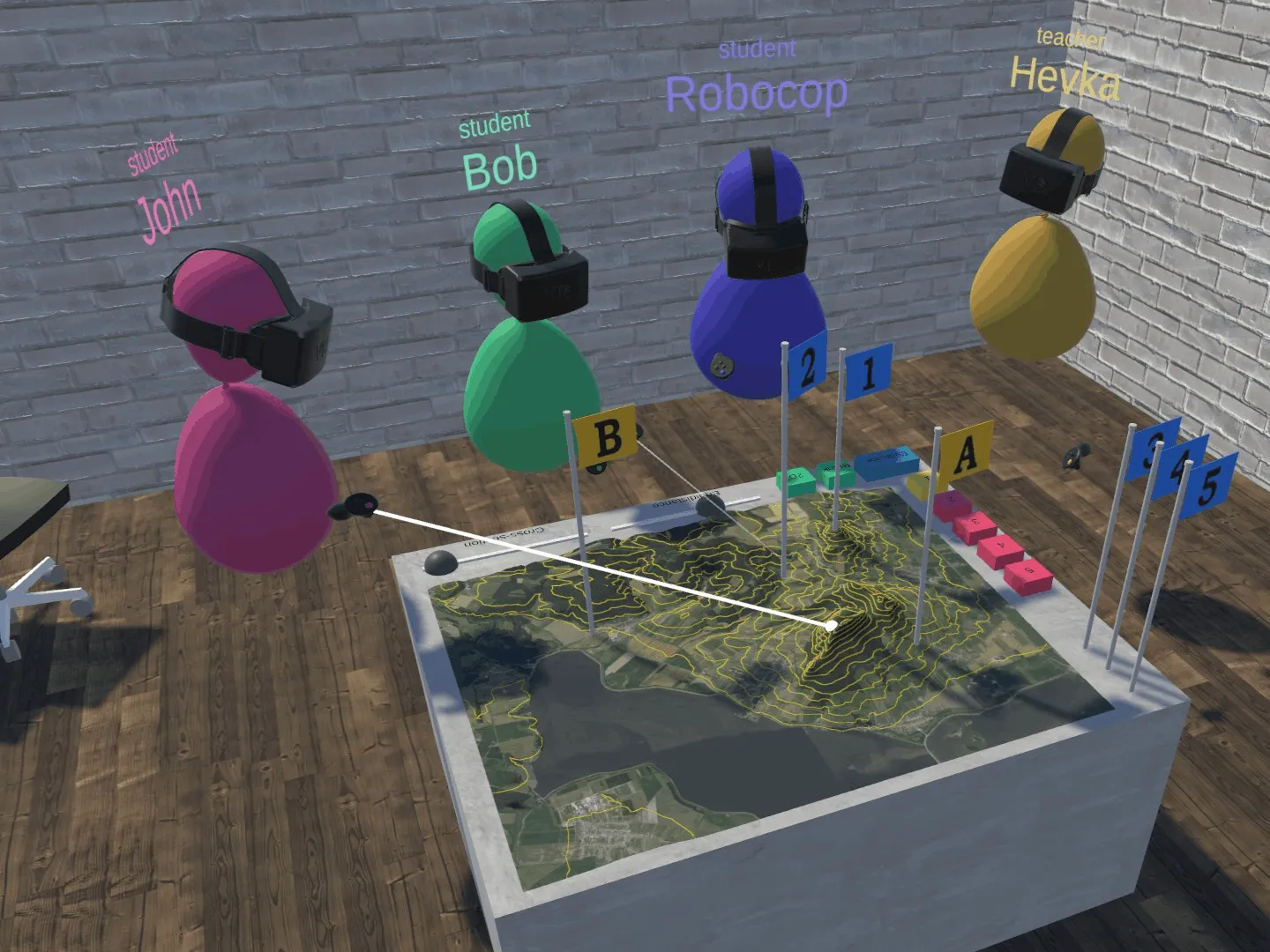
- For Users (Educators & Students): The platform delivers tailored teaching tools (such as in-VR slideshows and metrics) and immersive collaborative environments. Crucially, it includes a non-intrusive PC-based “Observer” role, allowing researchers and teachers to evaluate students without breaking immersion.
Technical Architecture
The core of eDIVE is built on advanced, scalable engineering principles to support dynamic classroom management:
- Strict Modularity: The framework strictly separates the highly complex Core Module (handling networking, avatars, and synchronization) from individual Education Modules, highly promoting code reusability and clean project structures.
- Client-Server-Relay Topology: Implements a robust network topology capable of supporting multiple, concurrent classroom instances across different networks.
- Asymmetric Role Authority: Roles (Teacher, Student, Observer) are baked directly into the interaction and network layers. This allows for precise pedagogical control, such as determining which interactions require local versus global synchronization.
Validation Through Design (RtD)
To ensure the framework was both technically sound and pedagogically effective, we utilized a Research-through-Design (RtD) methodology, co-designing the system alongside educators and psychologists. We built and validated 7 distinct core scenarios (spanning multiple use cases) to test architectural extensibility:
- Contour Lines (Geography): Explored custom GPU shaders and auto-evaluation, featuring a specialized desktop PC interface that allowed convenient control over the session, overriding the default desktop controller used for interacting directly with VR objects.
- Climate Zones (Geography): Integrated 360° media for contextual environmental exploration and a custom VR interaction for manipulating spherical globe model.
- Social Geography (Geography): Implemented collaborative data visualization tools.
- Villa Immersion & Vocabulary (English): Focused on contextual language learning and immersive exploration within a virtual architectural model. Integrated 3D/2D drawing and spatial audio features embedded directly within the environment. Also tested the asymmetric Observer role, providing multiple targeted camera views for VR versus desktop participants.
- Prepositions & Blind Reconstruction (English): Tested spatial language acquisition through structured blind-building tasks.
- House Furnishing & Teacher Slideshows (English): Validated teacher-controlled UI elements and shared collaborative manipulation of virtual furniture.
- Grammar Auctions (English): Validated synchronizing competitive, round-based classroom bidding.
The platform underwent rigorous empirical validation, including continuous expert co-design, a qualitative study with 10 geography teachers, and long-term feedback from 4 developers over 15 months who confirmed significant reductions in development time.
Ecosystem Reality & Real-World Impact
Maintaining a custom multiplayer VR architecture within a small academic team presents an inherent challenge: the sheer development velocity of the commercial XR industry. Major tech companies dominate the broader social VR space, and game engines themselves (such as Unity) are continuously researching and releasing their own official multiplayer VR templates. Competing with the engineering scale of these commercial giants as an independent developer or small team is ultimately an impossible task.
However, eDIVE was never built to compete as a generalized commercial product. Its true value resided in its specialized focus on pedagogical control and research enablement. Commercial off-the-shelf platforms often force educators to adapt their teaching to the software’s rigid constraints. eDIVE flipped that paradigm, providing granular control over asymmetric classroom roles, custom interaction syncing, and specialized data metrics that generic tools simply do not support.
This targeted approach yielded substantial research benefits. Beyond its academic contributions, eDIVE successfully bridged the gap between a technical prototype and a practical application. The platform saw sustained real-world use and continues to empower researchers and educators at the Faculty of Arts, standing as a strong example of how bespoke open-source engineering can solve specialized problems that mainstream platforms cannot address.
Primary Research Contributions
- Modular Toolkit Architecture: Provides Unity-based modules and prebuilt apps that enable efficient reuse of assets, scripts, and models across diverse educational contexts.
- Streamlined Development Workflow: Significantly reduces development time and complexity using drag-and-drop templates and preconfigured core modules.
- Deep Customization & Extensibility: Moves beyond the limitations of fixed platforms by supporting custom functionality, real-world data integration, and specialized collaborative tools.
- Role-Based Inclusive Design: Delivers tailored, asymmetric capabilities for developers, teachers, students, and observers, making co-presence in VR accessible and pedagogically valuable.
Academic Publications
The capabilities, architecture, and impact of eDIVE are documented in a peer-reviewed academic journal as a core part of my PhD dissertation:
- Core Architecture: Brůža, V., Šašinková, A., Šašinka, Č., Stachoň, Z., Kozlíková, B., & Chmelík, J. (2025). Immersive and Interactive Learning With eDIVE: A Solution for Creating Collaborative VR Education Experiences. Computer Graphics Forum, 44(1), 1-15. https://doi.org/10.1111/cgf.70001